It doesn't look particularly fast-moving, so I must be missing something here that accounts for the legendary 100% mortality rate. Unless there's a giant vortex of electric eels, this stretch of water looks tamer than what those extreme kayakers were up to in HBO's recent docuseries.
I heard it described as follows: the full force of the river you see upstream has been turned on its side and the current goes down. You can’t pull against that, especially against curved, mossy, wet rocks
So as if an elephant were pulling you down beneath the water and you only had your strength to grip against it. Can’t be done.
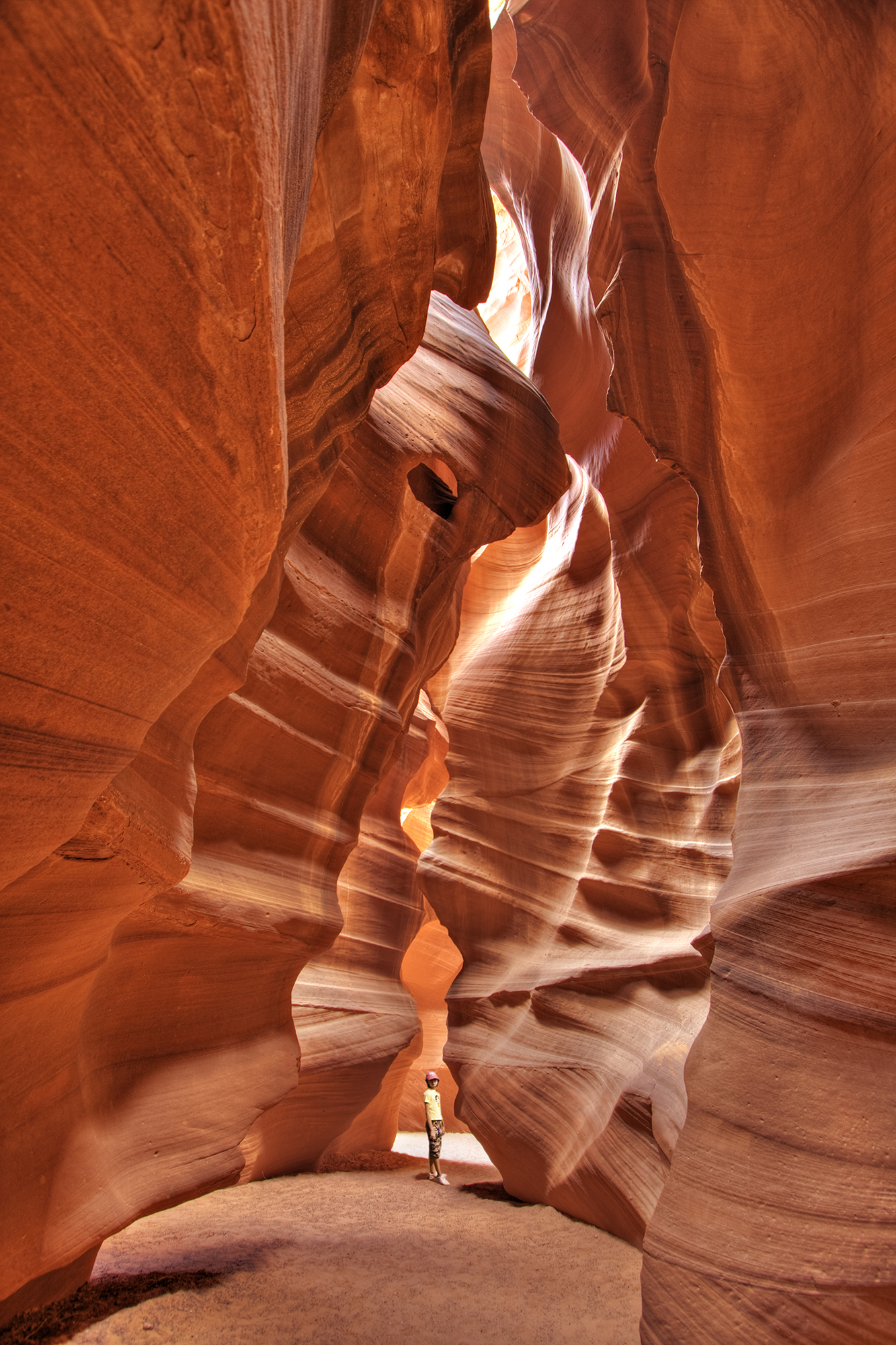
So parallels can be made to other places to show the danger. It's a slot canyon; only one that's generally constantly full versus empty most the year until the monsoon hits like those here in the US where I am. But the danger remains the same, the sandstone geology allows for it to create very deep and fast flowing situation due to Bernoulli's principle. Even more so for constrictions in the rock which form natural venturi.
<s>I looked but was not able to find CFM/CMM for the input and output</s>; but that would give a reasonable idea of what the volume of the canyon must be because what goes in must come out. So the volume of the flow at the outlet and inlet gives a very good idea of just how crazy it can be.
What I don't understand is how that works from a conservation of mass perspective. The water can't be literally flowing down at every point and keep a stable surface. I assume it's something more complicated, right.
In an incompressible flow (e.g. water under anything resembling normal circumstances), there is no net flow into or out of any given volume, i.e. a 3-D box or other shape. But the surface is 2-D! So you can look at a little box with its top at the surface and its bottom slightly below the surface. If there is downward flow out the bottom (and zero flow out the top, of course), there must be net inward flow in the sides. Nothing wrong with that.
This could happen if the river has constant speed and constant cross-sectional area everywhere but gets progressively narrower and deeper. The water moves inward because it has to get away from the encroaching banks and moves down to fill the deepening channel. If this is abrupt enough even in the absence of turbulence, the downward current a foot or so below the surface will be substantial.
Part of the difficulty of turbulent water is that it can really whip you and smash you around. It doesn’t necessarily look that violent from outside of the water, but you could be getting broken limbs and brain trauma in that kind of turbulence. The force of the water pressing you into walls and boulders is tremendous.
Loads of fatalities in turbulent water occur because the victim rapidly becomes unconscious in the water.
In addition to the explanations of the turbulent water smashing victims against the rock walls, presumably a very turbulent flow could also turn into a mixture of air and water, with a corresponding decrease in density such that it would be more difficult or even impossible for a person to maintain buoyancy.
It's an underground tunnel with a small exposed strip at the top.
the water can be circulating around the tunnel, flowing back and forth under the rocks. It can be pulling sideways or down at the exposed strip with the water circulating back up in the underground areas out at the sides.
I bet it's flowing horizontally but faster the deeper you go. You fall in, the higher speed flow at your feet apparently "sucks" you under due to its higher speed (higher inertia), like being grabbed by your ankles and yanked down.
Of course the flux of water into any volume is equal to the outward flux. But I would imagine the situation is that there are circulating turbulent branching streams of current pulling you down. If you were incredibly lucky, and not killed by impacting the walls, you might pop back up by catching a ride on another section of current.
What you are missing is that this is an extremely complex version of a drowning machine — very good read here [0].
Under the water is turbulence that just traps a person and keeps them tumbling underwater.
In addition the article points out that there are numerous rock outcroppings underwater against which an unfortunate person's head would likely get bashed, reducing or eliminating consciousness.
I also notice that the water is quite frothy and full of air bubbles. This reduces it's net density and thus reduces the buoyancy available to any objects that would otherwise float. It can be enough to sink ships [1].
So, basically, the turbulent water will pull you under, bash you hard against the rocks, give you less-than-normal buoyancy, and hold you under. It's kind of a toss-up whether you lose consciousness first from the head injuries or the lack of air, and after a few minutes of that, you're dead. Have a nice afterlife
I don’t know about in a kayak, but I imagine that the current is too strong for a swimmer to hold on. The water will also suck you down deep underneath, almost certainly lodging you into one of the tunnels for the short remainder of your life.
In a kayak if the waters too turbulent (frothy or foamy) you can lose buoyancy pretty hazardously and capsize really easily with poor chances of unaided recovery.
There's a few spots near me that are well known danger spots for kayakers due to this phenomenon.
The sides of the rocks are also angled out, so not only do you get sucked down, you get sucked down and out, so there's no chance of even swimming back up.
Ah, I was wondering about the extent to which it might pull you under. Like, is that quantified at all? Consistent or only in a few sections? And how does it compare with some of the world's other most dangerous rivers?
> The Strid (grade 5-) is a long thin section of river where the Wharfe narrows to 5-6 feet in places. The main problems are beneath surface in form of ledges which if you're swept under - you can forget it! At a higher level as seen in pictures, it's runnable. The pictures show med-high water and most of the ledges were covered. I'd have graded it at 5- this day. At lower levels it runs at class 5+ and many would portage, the ledges that trap you need divers to get to you and even good safety cover would be of little use in an entrapment situation. (2 tourists fell in at the Strid last year and one didn't emerge for nearly a week)
It's a pretty standard rating system. (I-VI--with the latter not being generally runnable) However, once you get to the highest levels there are unique features that can determine difficulty/danger. For example, if you do dump, is there a quiet section at the end of the rapid or is it miles of the same thing?
Don't know about quantified, but some of the underwater videos show bubble entrainment in some kind of shear flow 25+ meters down, which indicates a terrifying amount of velocity and power pushing downwards.
> What is known is that a powerful undercurrent will pull anybody that falls into certain death.
> The reason for the dangerous network of caves is just further up above the mouth of the Bolton Strid the river flows 30ft wide and a lot easier giving a more idyllic, romantic and tranquil flow before being disrupted by a geological formation that abruptly funnels hundreds of gallons of water through a tiny six-foot channel.
So, the surface appears tranquil, but under the surface is a swift turbulent undercurrent.
I've not seen the documentaries you refer. But kayakers know that danger of a water feature doesn't necessarily correlate with how violent it looks on the surface. Plenty of very quiet weirs are known to be fatal while plenty of noisy ones (though not all!) will spit you out unharmed.